Ban the (Sun) Beds: The Case for Full Commercial Sunbed Ban in Aotearoa
Cosmetic and artificial tanning is often framed as harmless self care, promoted as a more optimal and “safer” alternative to direct sun exposure. It is positioned within westernised beauty markets as a seasonal refresh and a routine appointment before holidays and special events, or even as a regular ritual at the end of the working week in preparation for social plans and weekends out. Simply put, a “bronzed glow” is marketed as a marker of vitality, with artificial tanning normalised as routine aesthetic upkeep rather than acknowledged as a potential medical risk.
It is within this context of normalisation, commercial tanning beds continue to operate across Aotearoa.
This stands in clear tension with Aotearoa’s public health strategy, which places strong emphasis on cancer prevention and early detection, particularly given the country’s position among those with the highest rates of melanoma in the world.
Tanning beds are not neutral cosmetic tools. They emit ultraviolet radiation classified by the World Health Organisation as a Group 1 carcinogen, in the same category as tobacco and asbestos. Some devices are capable of emitting ultraviolet levels stronger than the midday summer sun.
The gap between carcinogenic risk and continued commercial availability warrants serious scrutiny.
Consumer research reinforces the scale of that risk. Data cited by Consumer NZ indicates that individuals who first use sunbeds before the age of 30 increase their risk of developing melanoma by 75 percent. This represents a substantial and preventable escalation in lifetime cancer risk, particularly troubling in a country already facing disproportionately high rates of melanoma.
Australia and New Zealand consistently record amongst the highest melanoma incidence rates globally. In this context, policy settings that permit commercial artificial ultraviolet exposure appear inconsistent with prevention priorities.
Where does reform currently stand?
New Zealand introduced partial reform in 2017. Under the Health Act 1956, it became illegal for commercial operators to allow individuals under 18 years of age to use a sunbed. The reform acknowledges the heightened vulnerability of young people to ultraviolet damage and cumulative lifetime exposure.
However, restricting access for minors does not address the broader regulatory gap.
Enforcement has relied heavily on operator compliance with voluntary standards, and monitoring has not always been consistent. Where commercial incentives intersect with carcinogenic exposure, voluntary compliance offers limited protection. A regulatory approach that restricts youth access while maintaining adult commercial availability reflects compromise rather than coherence.
Australia provides a relevant comparator.
Following the introduction of a nationwide ban on commercial solaria, the Australian Radiation Protection and Nuclear Safety Agency (ARPANSA) reported a substantial projected long term benefit. A modelling study examined the cohort of Australians aged 12 to 35 years in 2007, representing 6.95 million people, and estimated the lifetime health and economic impact of the ban compared with a scenario in which no prohibition was implemented.
The findings were significant. The ban was projected to prevent 31,009 melanomas, 3,017 melanoma deaths, and 468,249 keratinocyte cancers over the lifetime of that cohort. When accounting for both healthcare costs and productivity losses associated with cancer, the economic benefit to the Australian economy was estimated to exceed over 580 million dollars.
The evidence demonstrates that prohibition is not merely symbolic. Rather, it produces measurable health gains and substantial economic savings.
The central question for Aotearoa is therefore not whether tanning beds cause harm. The scientific consensus linking artificial ultraviolet exposure to melanoma has been established for more than two decades. The question is whether continued commercial availability aligns with national cancer prevention strategy and fiscal responsibility.
Public health regulation in other areas involving carcinogenic exposure has been decisive. Tobacco control and asbestos regulation are examples of reforms that reflect a consistent principle: when harm is established and preventable, access is restricted and imposed.
Artificial tanning devices should not be treated as an exception.
A nationwide prohibition on commercial sunbeds would align regulation with evidence and considerably reduce preventable cancer risk. Public health messaging, alongside skin cancer prevention campaigns, significantly lose coherence and integrity when commercial carcinogenic exposure remains legally accessible.
The epidemiology is clear. The economic standpoint is clear. The policy pathway is equally clear.
What remains is legislative resolve and enforceable action.
WAYS TO HELP
Policy reform is inevitably strengthened and advanced through informed civic engagement.
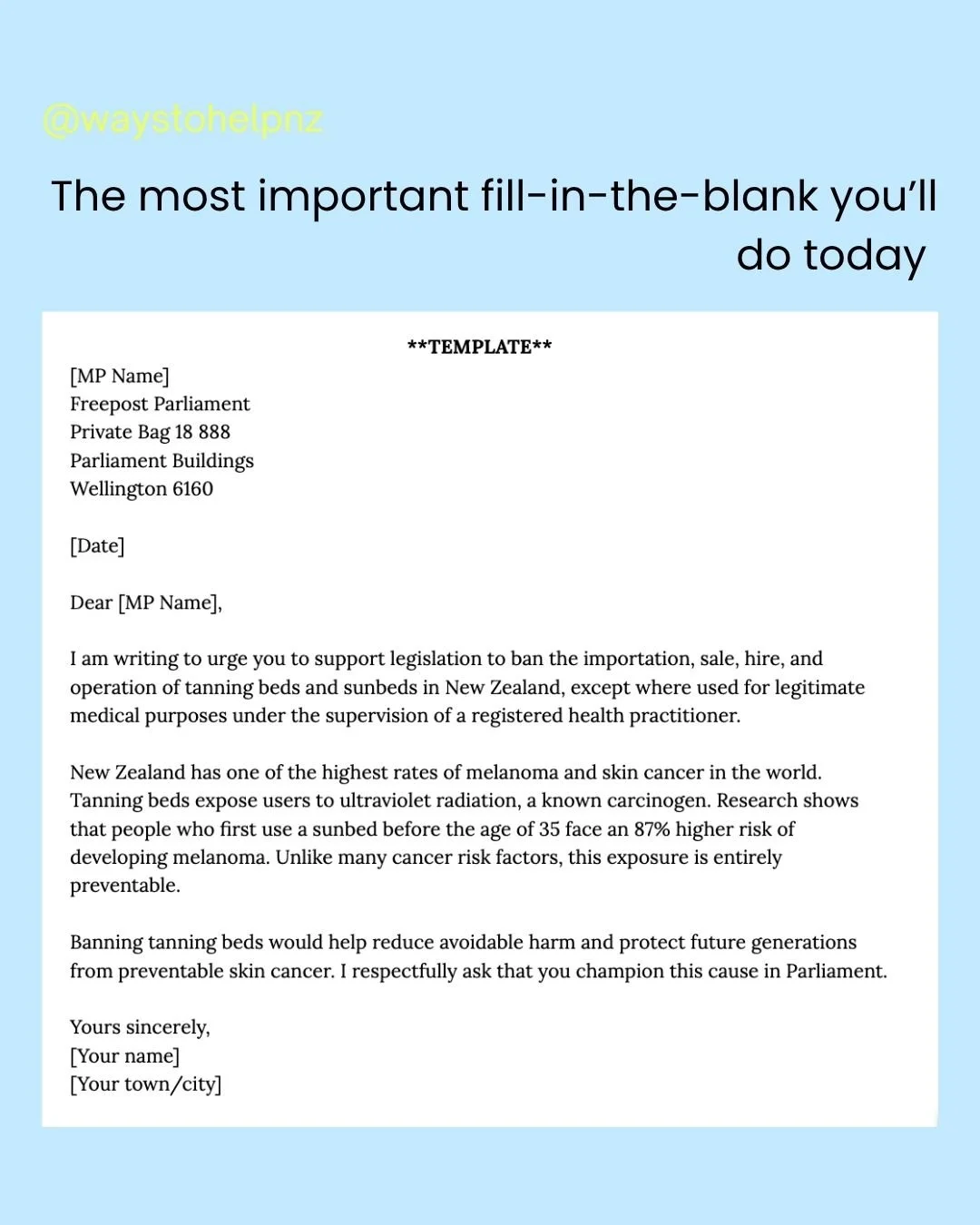
If you support a full commercial sunbed ban in Aotearoa, consider writing to your local Member of Parliament. Direct correspondence signals that this issue carries public relevance.
For detailed guidance on this, please refer to our adaptable letter template below.
Prevention is most effective when evidence and policy move in alignment.
References and Further Resources:
ARPANSA, Study shows the benefit of the Australian ban on commercial solaria:
Belinda Castles, Time to ban sunbeds, Consumer NZ: https://www.consumer.org.nz/articles/time-to-ban-sunbeds
WHO, Artificial Tanning Devices: https://iris.who.int/server/api/core/bitstreams/1a65e75b-8314-49a2-b678-6d65f3848010/content
